A Knife Injury Does Not Automatically Justify a Fatal Barrage
The fatal police shooting of Corey Ruiz in Madison, Wisconsin, raises a difficult but necessary question: Was the force used proportionate to the threat officers faced at the exact moment the shots were fired?
By Mitch Thorne ·
July 23, 2026 · 45 views
Madison, Wisconsin - The fatal police shooting of Corey Ruiz in Madison, Wisconsin, raises a difficult but necessary question: Was the force used proportionate to the threat officers faced at the exact moment the shots were fired?
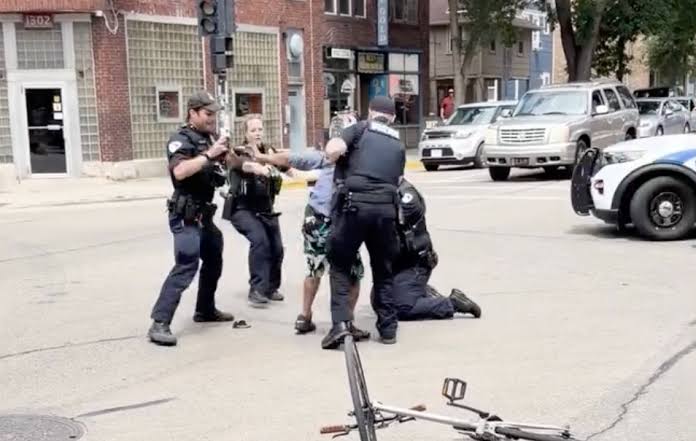
Ruiz, a Black man in his 30s, was killed on July 22, 2026, after four Madison police officers attempted to detain him at the intersection of Williamson Street and South Baldwin Street. Police had initially responded to reports of a man checking vehicle doors and allegedly attempting to steal bicycles. Neither allegation involved a violent crime.
According to Madison Police Chief John Patterson, Ruiz fled on a bicycle before officers encountered him again at the intersection. A physical struggle followed. Police say officers attempted to use a Taser, but it failed. They allege that Ruiz then produced a fixed-blade knife and injured one of the officers. That officer drew his gun and fired multiple rounds at close range.
Two officers were taken to a hospital. The officer who fired the fatal shots reportedly suffered a knife injury, while another officer sustained minor injuries unrelated to the knife. Both were treated and released. Authorities have not disclosed the location, depth or seriousness of the alleged knife wound.
That missing information matters.
The existence of a knife does not automatically settle whether deadly force was justified. The central question is not simply whether Ruiz possessed a weapon or whether an officer was injured. Investigators must determine whether Ruiz still posed an imminent threat of death or great bodily harm when the officer fired.
Wisconsin law and Madison Police Department policy describe deadly force as a measure of last resort. Its use depends on whether less-lethal options were ineffective or unavailable and whether a reasonable officer would have believed that an immediate deadly threat remained.
The distinction between a knife and a gun is also impossible to ignore. A knife can cause serious or fatal harm at close range, particularly during a physical struggle. But a firearm delivers lethal force from a distance and can fire multiple rounds within seconds. When four officers are struggling with one person, the number of officers present, the man’s position and the location of the knife at the moment of the shooting become essential to deciding whether gunfire was necessary.
Witness accounts and bystander video have intensified those questions. Some witnesses have reportedly claimed that the knife fell or was discarded before Ruiz was shot. Video appears to show him on his knees or close to the ground during the confrontation. Protesters have argued that the shooting looked less like an effort to stop an immediate attack and more like an execution.
Those claims have not yet been established as fact, but they cannot be dismissed. The official police account must be measured against the video, witness statements, forensic evidence and the timing of every shot.
The fact that an officer was injured does not give police unlimited authority to use deadly force afterward. Deadly force is meant to stop an imminent threat, not punish someone for an injury that has already occurred. If the knife was no longer in Ruiz’s hand, if he had been brought under control, or if the danger had otherwise passed, multiple gunshots would be difficult to justify as a last resort.
The absence of body-worn camera footage makes the investigation even more dependent on bystander recordings, squad car footage and independent witnesses. None of the four officers involved was wearing a body camera. The Wisconsin Department of Justice Division of Criminal Investigation is now handling the case, and all four officers have been placed on administrative leave.
The investigation must determine more than whether Ruiz had a knife. It must establish where the knife was when the shots were fired, whether Ruiz was still attempting to use it, whether officers had control of his body, how serious the officer’s injury was and whether continued gunfire was proportionate to the remaining danger.
A knife injury may explain why an officer feared for his safety. It does not, by itself, prove that firing multiple close-range gunshots was lawful, necessary or proportionate. Accountability depends on examining the precise moment deadly force was used, not merely repeating what happened seconds before it.